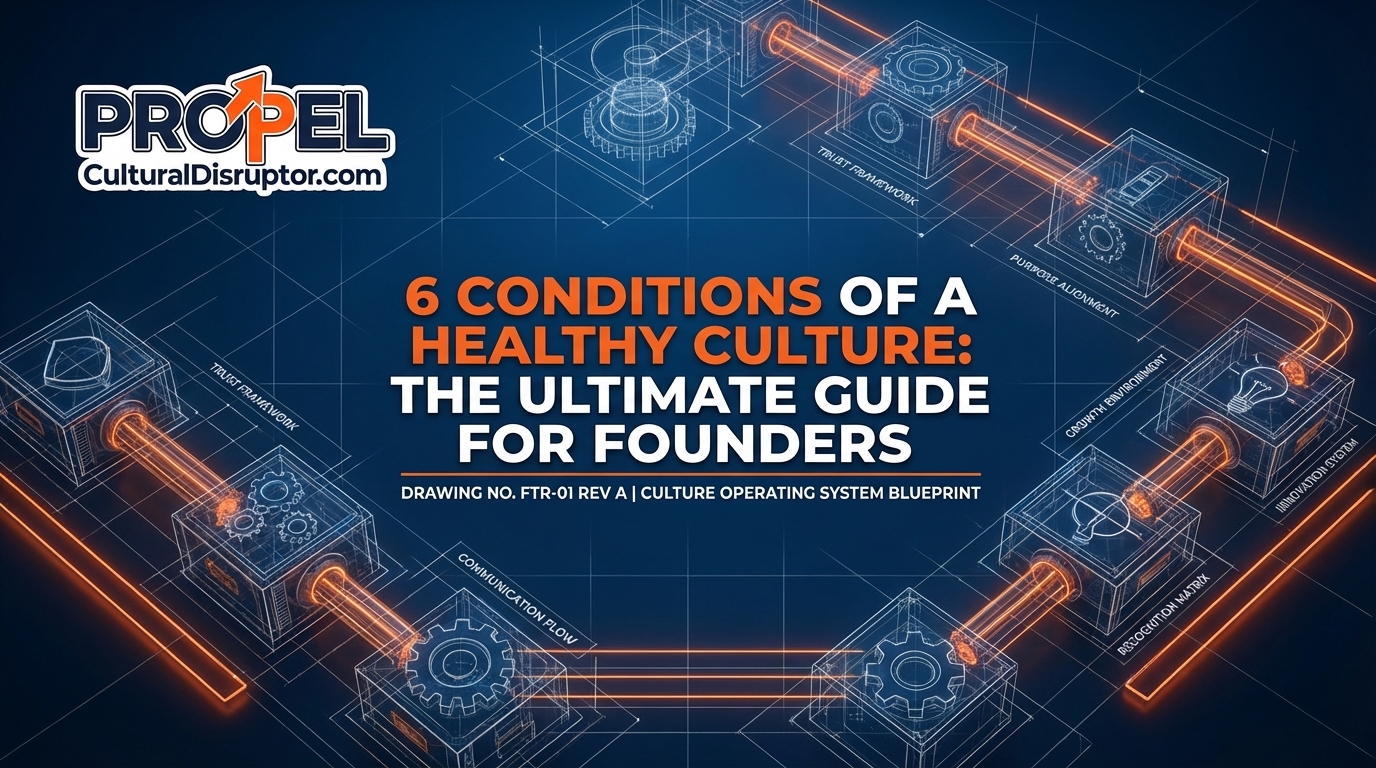
6 Conditions of a Healthy Culture: The Ultimate Guide for Founders
The 6 Conditions of a Healthy Culture: A Founder’s Field Guide to High-Performance Teams
Most founders treat culture like a "vibe"—something intangible that happens when you hire nice people and buy a ping-pong table. But culture isn't a feeling; it is a structural outcome. If your team is struggling with missed deadlines, internal friction, or a lack of initiative, you don't have a "people problem." You have a structural problem. A healthy culture is the byproduct of specific environmental conditions that allow high-performers to thrive without the founder having to micromanage every moving part.
At Propel — Cultural Disruptor, we’ve spent 30 years dismantling the myth that leadership is about personality. It’s about precision. To build a self-managing organization, you must install the right Cultural Operating System. This requires moving beyond surface-level perks and focusing on the skeletal framework that holds a team together. Without this structure, even the best talent will eventually burn out or check out.
This guide breaks down the 6 structural conditions that every high-performing team runs on. We will move through Clarity, Communication, Chemistry, Collisions, Collaboration, and Contribution. By the end of this article, you will be able to audit your own organization and identify exactly where the structural integrity of your culture is failing.
What Are the 6 Conditions of a Healthy Culture?
The 6 conditions of a healthy culture are the structural pillars of Clarity, Communication, Chemistry, Collisions, Collaboration, and Contribution. When these six elements are aligned, they create an environment of psychological safety, high accountability, and extreme ownership. This framework allows founders to step back from daily operations while the team self-manages toward shared goals.
Each condition serves a unique purpose in the organizational ecosystem. Clarity provides direction; Communication ensures flow; Chemistry builds the bond; Collisions spark innovation; Collaboration drives execution; and Contribution provides the meaning that sustains long-term engagement. If even one of these conditions is missing, the culture begins to degrade into silos, apathy, or high turnover.
Condition 1: Clarity — The North Star of Alignment
Clarity is the first and most critical condition. Without it, your team is just a group of people rowing in different directions. Clarity isn't just about having a mission statement on the wall; it’s about every single team member knowing exactly what the "win" looks like for the company, the department, and their specific role. When clarity is missing, anxiety fills the void. Employees spend more time guessing what you want than actually doing the work.
Communicating Purpose and Values
A healthy culture requires a shared understanding of why the organization exists. This purpose must be communicated consistently and integrated into every decision-making process. Values shouldn't be aspirational adjectives; they should be behavioral standards. If one of your values is "Extreme Ownership," but you promote people who shift blame, you have a clarity gap that will eventually erode trust across the entire organization.
Role Precision and Outcome Ownership
Role clarity is the antidote to the "that’s not my job" mentality. In a high-performing culture, employees don't just have a list of tasks; they have a defined area of ownership. They should know which Key Performance Indicators (KPIs) they are responsible for and how those metrics impact the bottom line. This level of precision allows for autonomy because the boundaries of the "playground" are clearly defined.
Condition 2: Communication — People-Centric Leadership and Radical Transparency
Communication is the nervous system of your culture. In many organizations, communication is top-down and selective, which breeds rumors and resentment. A healthy culture requires radical transparency—the practice of sharing information, even when it’s uncomfortable. This includes being open about financial health, strategic pivots, and the reasoning behind major leadership decisions.
Fostering Open Communication Channels
Open communication means that information flows freely in all directions: upward, downward, and laterally. Leaders must actively seek out feedback from the front lines, and employees must feel safe enough to share the "ugly truth" without fear of retribution. This requires a shift from a "need-to-know" basis to a "transparency-by-default" mindset. When people are kept in the dark, they stop feeling like partners and start feeling like tools.
Transparency in Decision-Making
One of the biggest culture killers is "black box" decision-making. When a team doesn't understand the why behind a change, they are less likely to buy into the how. People-centric leadership involves explaining the logic, data, and constraints that led to a specific outcome. Even if the team disagrees with the final decision, they are much more likely to respect it if the process was transparent and their input was considered.
Condition 3: Chemistry — Psychological Safety and Meaningful Relationships
Chemistry is about more than just liking your coworkers; it’s about deep-seated trust and psychological safety. This is a concept popularized by Harvard researcher Amy Edmondson and a major Google study (Project Aristotle), which found that psychological safety—the belief that you won't be punished for making a mistake—is the number one predictor of team success.
Building Meaningful Relationships
Healthy cultures prioritize the human element. This doesn't mean forced fun or awkward team-building exercises. It means creating space for people to show up as their authentic selves. When employees feel a personal connection to their peers, they are more likely to support one another during high-pressure periods. Chemistry acts as the shock absorber for the inevitable stresses of business growth.
The Role of Trust and Vulnerability
Trust is built when leaders model vulnerability. If a founder can't admit when they're wrong or don't have the answer, the team will mirror that behavior, leading to a culture of perfectionism and cover-ups. In a healthy culture, "I don't know" or "I messed up" are seen as signs of strength, not weakness. This vulnerability creates the safety necessary for high-stakes problem-solving and rapid learning.
Condition 4: Collisions — Fostering Constructive Conflict
Most leaders fear conflict. They think a "good culture" is one where everyone agrees. They are wrong. A healthy culture requires Collisions—the friction of ideas that leads to innovation. If your team is too polite to challenge each other, you are leaving your best ideas on the table. The goal isn't to eliminate conflict, but to manage it constructively.
Practicing Constructive Conflict Management
Constructive conflict is task-oriented, not person-oriented. It’s the difference between saying "That idea won't work because of X" and "You're an idiot for suggesting that." Healthy cultures have clear protocols for how to disagree. They encourage "productive pushback" where employees are expected to challenge assumptions in the pursuit of the best possible outcome. This ensures that the "loudest voice" doesn't always win.
Serendipitous Collisions in Remote/Hybrid Work
In a physical office, collisions happen naturally at the coffee machine. In a remote or hybrid world, they must be engineered. Founders need to create digital spaces—like "No-Agenda" Zoom rooms or Slack channels focused on specific problems—where cross-functional team members can bump into each other’s ideas. Without these planned collisions, departments become silos, and the organization loses its agility.
Condition 5: Collaboration — Empowerment and Autonomy-Driven Performance
Collaboration is the act of working together toward a shared outcome, but it only works when there is a high degree of autonomy. If every decision requires founder approval, you don't have collaboration; you have a bottleneck. A healthy culture empowers individuals to make decisions within their domain, trusting them to use the resources and information provided to them.
Autonomy and Team Empowerment
Empowerment is not a gift you give; it’s a structure you install. It involves defining the "Who, What, and How" of decision-making. High-performing teams use frameworks like Decision Flow Analysis to determine who has the final say in specific scenarios. When employees feel they have the agency to solve problems, their engagement skyrockets. They stop waiting for instructions and start driving results.
Breaking Down Silos
Effective collaboration requires the removal of structural barriers between departments. Sales, Marketing, and Operations should not be competing for resources; they should be aligned on the same customer-centric goals. Healthy cultures use shared KPIs to ensure that when one team wins, the whole company wins. This prevents the "us vs. them" internal politics that destroy productivity.
Condition 6: Contribution — Meaningful Work and Growth
The final condition is Contribution. Humans have an innate need to know that their work matters and that they are growing. If a job is just a series of repetitive tasks with no growth path, even the most loyal employee will eventually look elsewhere. A healthy culture provides meaningful work by connecting individual efforts to the larger company mission.
Providing Meaningful Work and Recognition
Recognition is the fuel of contribution, but it must be specific and timely. Vague "Employee of the Month" awards are filler. Real recognition is highlighting a specific action an employee took that embodied a company value or solved a critical problem. This reinforces the behaviors you want to see and makes the employee feel seen and valued for their unique contribution.
Growth and Professional Development Opportunities
A culture of growth is a culture of retention. Founders must invest in the professional development of their people—not just to make them better at their current jobs, but to prepare them for their future roles. This includes mentorship, coaching, and a clear "career ladder" or "career lattice." When people see a future for themselves within your organization, they are much more likely to invest their best energy into its success.
Condition 7: The 2025 Add-on — Social Responsibility and Ethics
In the modern landscape, a seventh condition has emerged: Social Responsibility. According to recent McKinsey research, employees—especially Millennials and Gen Z—increasingly view "Acting Responsibly" as a non-negotiable condition for organizational health. This goes beyond corporate philanthropy; it’s about the ethical backbone of the business.
Founders can no longer ignore the social and environmental impact of their companies. A healthy culture in 2025 and beyond requires a commitment to Diversity, Equity, and Inclusion (DEI) and a clear stance on ethical business practices. If a company claims to care about its people but ignores the broader community or operates in an ethical gray area, the resulting cognitive dissonance will eventually drive away high-integrity talent.
Holistic Well-being: Physical, Mental, and Financial Security
You cannot have a healthy culture with unhealthy people. Prioritizing well-being and work-life balance is not a "soft" benefit; it is a business imperative. Burnout is the enemy of innovation. A healthy culture recognizes that employees are whole people with lives outside of work. This means providing the security—financial, physical, and mental—necessary for them to bring their best selves to the table.
This includes offering competitive compensation, comprehensive health benefits, and mental health support. But it also includes "cultural permissions," like the right to disconnect after hours or the flexibility to handle family emergencies without guilt. When the organization cares for the person, the person cares for the organization. It is a reciprocal relationship that forms the bedrock of long-term stability.
How to Audit Your Culture: A 6-Point Health Checklist
To determine which of the 6 conditions your organization is missing, you must look at the data. Use this checklist as an initial audit of your cultural health:
- Clarity Audit: Can every employee articulate the company's top 3 goals for this quarter? If not, you have a clarity gap.
- Communication Audit: Do you have a structured feedback loop where employees can share concerns anonymously? If not, you lack transparency.
- Chemistry Audit: What is your employee Net Promoter Score (eNPS)? Do people trust their immediate supervisors?
- Collisions Audit: When was the last time an entry-level employee successfully challenged a leadership decision? If you can't remember, you've stifled collisions.
- Collaboration Audit: How often are projects delayed because they are waiting for your (the founder's) approval? This measures your autonomy level.
- Contribution Audit: Does your recognition system reward outcomes or just "hours worked"? Do you have a documented growth plan for every key role?
The Role of Tech and AI in Cultural Evolution
Digital transformation is fundamentally changing how cultural conditions are maintained. AI can now assist in measuring sentiment analysis through "Pulse Checks," giving founders real-time data on team morale before turnover spikes. Tools like Propel IQ™ act as an intelligence layer, helping leaders identify hidden friction points and mapping team compatibility with data-driven precision.
However, tech is a double-edged sword. While it can enhance communication and clarity, it can also create isolation. The challenge for modern founders is to use technology to support human connection, not replace it. AI should be used to automate the "drudge work," freeing up humans to focus on the high-level collaboration and contribution that only they can provide. Technology should serve the culture, not the other way around.
Conclusion: Building a Culture That Lasts in a Hybrid World
Building a healthy culture is not a one-time event; it is a continuous process of installation and maintenance. By focusing on the 6 conditions—Clarity, Communication, Chemistry, Collisions, Collaboration, and Contribution—you are building a Cultural Operating System that is resilient to market changes, remote work challenges, and growth pains.
The most successful founders are those who realize that their primary product isn't what they sell—it’s the team they build. When you get the conditions right, high-performance becomes the default. You can stop carrying the weight of the entire organization on your shoulders and start leading with the precision and confidence that only data-driven insights can provide.
Ready to Get Started?
Propel gives you data-driven people insights so you lead with precision — not personality or gut feeling, installing the structure that empowers teams to self-manage, collaborate, and own their outcomes.
Visit Our Homepage


