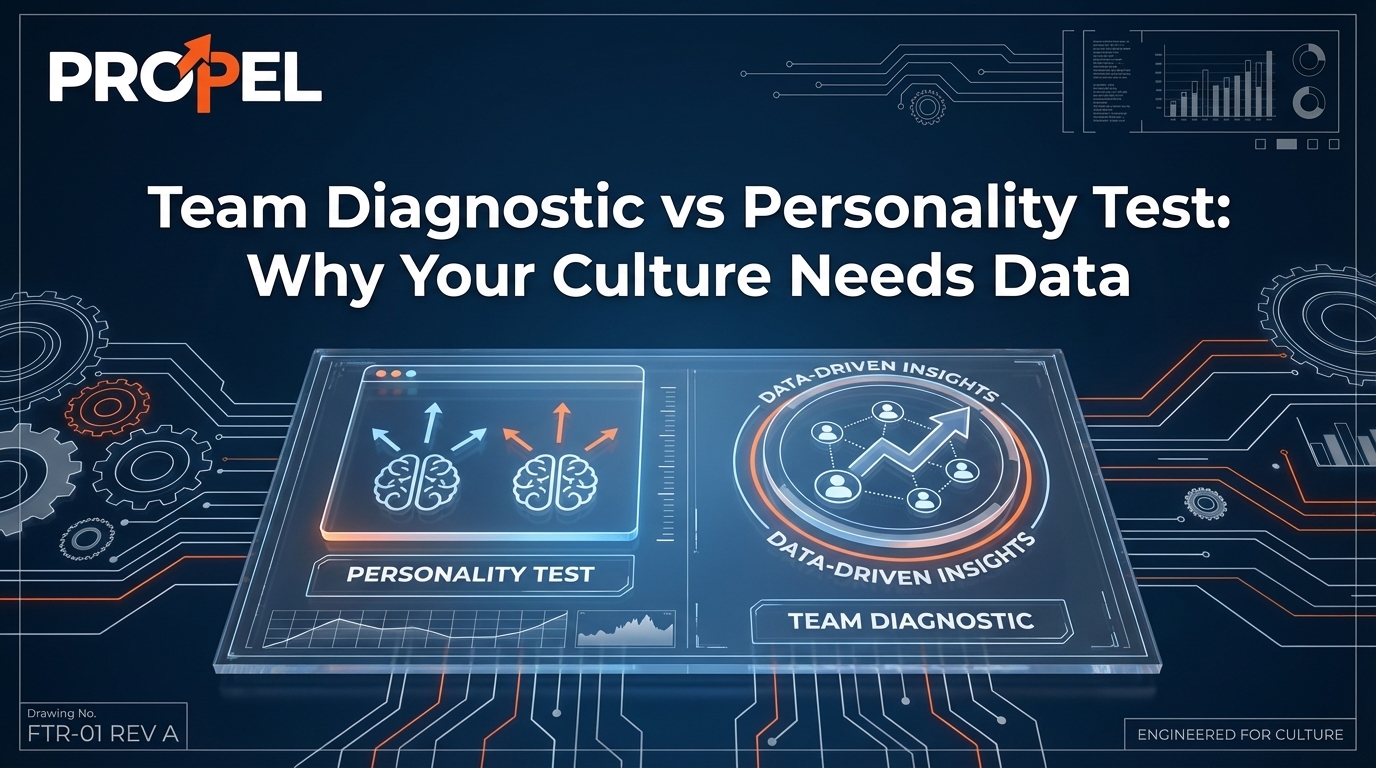
Team Diagnostic vs Personality Test: Why Your Culture Needs Data
Why Your Team Needs a Diagnostic, Not a Personality Test
You’ve been there before. You gather your leadership team in a conference room, hand out color-coded badges, and spend four hours discussing whether someone is an "Introverted Analytical" or an "Extroverted Driver." Everyone leaves feeling enlightened for exactly forty-eight hours. Then, Monday morning hits. The same silos reappear. The same communication breakdowns stall your projects. The founder—you—is back to carrying the entire emotional and operational weight of the company. This is the fundamental failure of the personality-first approach to team building.
What is the difference between a team diagnostic and a personality test? A personality test focuses on individual traits and self-awareness, while a team diagnostic measures the systemic health, trust, and operational alignment of the group as a single unit. While personality tests provide "labels," diagnostics provide a roadmap for high-performance execution and collective accountability.
1. Introduction: The High Cost of 'Feel-Good' Team Building
For decades, the corporate world has been obsessed with the "Who." Who are you? How do you think? What makes you tick? While self-awareness is a noble pursuit, it is a terrible foundation for building a high-growth business. Many founders fall into the trap of thinking that if they simply understand their people better, the business will magically run itself. They invest thousands of dollars into Enneagram workshops or Myers-Briggs assessments, hoping to solve deep-seated cultural friction with a few psychology charts.
The Illusion of Progress
The problem is that these assessments are "feel-good" interventions. They offer an immediate hit of dopamine because people love talking about themselves. However, knowing that your Head of Operations is an "INTJ" doesn't tell you why your quarterly targets were missed or why your remote team is suffering from burnout. It provides an explanation for behavior but offers no structure for improvement. In a high-stakes environment, explanation without execution is just expensive venting.
The Reality of Cultural Friction
Culture is not a collection of personalities; it is the sum of your systems, expectations, and accountability structures. When you focus solely on personalities, you are treating the symptoms rather than the root cause. You are trying to fix the passengers when the engine of the car is actually broken. A diagnostic shifts the focus from the people in the seats to the vehicle itself, identifying exactly where the friction is preventing you from reaching top speed.
2. Diagnostic vs. Personality Test: Defining the Core Difference
To understand why your team is underperforming, you must first understand what you are measuring. A personality test is an internal mirror—it shows an individual how they perceive themselves. A team diagnostic is a 360-degree X-ray of the team’s collective health. One is about identity; the other is about functionality.
Feature Personality Test (e.g., DiSC, MBTI) Team Diagnostic (e.g., Propel Briefing) Primary Focus The Individual The System / The Team Output Labels and Traits Performance Gaps and Action Plans Predictive Value Low (Traits ≠ Performance) High (Identifies operational bottlenecks) Sustainability Short-term awareness Long-term cultural infrastructurePredictive Validity: Traits vs. Performance
Research consistently shows that individual personality traits are poor predictors of team success. You can put five "high-performers" with perfect personality profiles in a room, and they can still fail miserably if the team lacks psychological safety or clear decision-making flows. A diagnostic doesn't care if you're an introvert; it cares if you feel safe enough to point out a flaw in the project plan. It measures the interactions between people, which is where 90% of business value is either created or destroyed.
Self-Reporting Bias in Assessments
Another critical flaw of personality tests is the self-reporting bias. People answer based on who they want to be or who they think the boss wants them to be. A team diagnostic, particularly one like the Propel Briefing, looks at objective patterns and collective feedback. It bypasses the ego and looks at the mechanics of how work actually gets done. It’s the difference between asking someone if they’re a good driver and looking at their actual telematics data from the last six months.
3. The Three Fatal Flaws of Personality-First Team Building
Why do personality tests fail to improve performance over the long haul? It usually comes down to three systemic issues: pigeonholing, static results, and the creation of individual silos.
Flaw #1: The 'Labeling' Problem
Once you give someone a label—"The Visionary," "The Analytical," or "The Skeptic"—it often becomes a crutch. Instead of growing, employees use their personality type to excuse poor behavior. "I'm not being rude; I'm just a High-D on the DiSC scale." This limits personal growth and creates a fixed mindset. A diagnostic avoids this by focusing on competencies and behaviors that can be changed, rather than inherent traits that are supposedly fixed.
Flaw #2: Static Results in a Dynamic World
Your personality might stay relatively stable over ten years, but your team’s challenges change every week. A test you took three years ago is irrelevant to the merger you’re going through today or the remote-work transition you managed last year. Diagnostics are snapshots of the current state of the team. They are dynamic tools meant to be used frequently to adjust the "Cultural Operating System" as the business scales.
Flaw #3: Creating Individual Silos
Personality tests emphasize how we are different. While this can foster empathy, it often highlights divisions rather than common goals. If your team building only focuses on how different everyone is, you’re missing the connective tissue. A diagnostic identifies shared language and group accountability. It focuses on the "What" and the "How" that everyone must commit to, regardless of their personality profile.
4. Why Your Team Functions Better as a System: The Diagnostic Advantage
A team is not a group of people who work together; a team is a group of people who trust each other and share a common goal. This distinction is the core of the diagnostic approach. When you treat the team as a system, you begin to see that performance is a result of the environment you’ve built, not just the people you’ve hired.
Individual Strengths vs. Group Accountability
In a personality-driven culture, the focus is on maximizing individual strengths. While good, this often leads to a "star culture" where individuals shine but the team fails. A diagnostic measures Group Accountability. Do team members feel responsible for each other’s success? Are they willing to have difficult conversations to ensure the project succeeds? These are systemic behaviors that a personality test simply cannot track.
The 'Diagnostic Trap': Moving to Implementation
A warning for founders: do not fall into the "Diagnostic Trap" of over-analyzing without shifting into the implementation phase. Some diagnostics are so complex they lead to analysis paralysis. At Propel, we believe a diagnostic is only as good as the Cultural OS Installation that follows. The goal isn't to have a 50-page report; the goal is to have three clear actions that will reduce friction in next week's leadership meeting.
5. The Science of Team Health: Frameworks That Matter
High-performing teams aren't an accident. They are built using proven frameworks that prioritize the group dynamic over the individual. When conducting a team diagnostic, we look at three pillars of modern team science: Lencioni’s Model, the Team Diagnostic Survey (TDS), and Google’s Project Aristotle.
The Foundation of Trust (Lencioni's Model)
Patrick Lencioni’s "5 Dysfunctions of a Team" is a cornerstone of team diagnostics. It posits that without Vulnerability-Based Trust, everything else falls apart. You can't have healthy conflict without trust. You can't have commitment without conflict. You can't have accountability without commitment. And you can't have results without accountability. A personality test might tell you why someone struggles to trust, but a diagnostic tells you that trust is missing and provides the steps to build it.
Google’s Project Aristotle and Psychological Safety
After studying hundreds of teams, Google found that the most important factor in team success was Psychological Safety. This has nothing to do with personality types. It’s about the team's shared belief that it’s safe to take risks. A diagnostic measures this safety level accurately across the whole group, allowing founders to see where they are inadvertently stifling innovation through fear or lack of clarity.
6. Case Study: Shifting from 'Who We Are' to 'How We Work'
Consider a mid-sized construction firm where the founder was pulling 80-hour weeks. He had invested in DiSC assessments for his project managers. They knew who was "Dominant" and who was "Steady," yet project delays were rampant and communication between the field and the office was non-existent. The founder thought he had a "people problem"—that he just hadn't hired the right personalities.
The Diagnostic Revelation
When Propel ran a Motivational Diagnostic, the data revealed something the personality tests missed. The issue wasn't the people; it was a total lack of Decision Flow Analysis. The project managers didn't know what they were authorized to approve without the founder's sign-off. The "friction" wasn't personality-based—it was structural. By diagnosing the system, we were able to install a WHAT OS Decision Flow that allowed the team to self-manage.
The Outcome: Freedom for the Founder
Within 90 days of shifting from personality discussions to systemic diagnostics, the founder’s workload dropped by 20 hours a week. The team wasn't "different people," but they were operating within a different structure. They moved from asking "Who is to blame?" to "Where is the process breaking down?" That is the power of a diagnostic.
7. The Implementation Roadmap: 4 Steps to Running a Productive Team Diagnostic
Running a diagnostic is more involved than taking a 10-minute online quiz, but the ROI is infinitely higher. Here is the four-step roadmap we use at Propel to move teams from confusion to precision.
Step 1: Data Collection & Cultural Pulse
The diagnostic begins with an honest, anonymous assessment of the team’s current dynamics. This includes measuring trust, clarity of mission, and the efficiency of current workflows. We aren't looking for how people feel about their coworkers; we are looking for how they feel about the work and the culture.
Step 2: The Radical Truth Debrief
Once the data is in, the team meets to review the findings. This is where the "Cultural Disruptor" element comes in. We don't sugarcoat the results. If there is a lack of trust in leadership, we name it. If the team feels the meetings are a waste of time, we look at the data. This transparency creates a shared reality—a necessary precursor to change.
Step 3: Structure Installation
We don't leave the team with just a debrief. We move immediately into installing the Culture Infrastructure. This might mean setting up a new cadence for stand-ups, defining clear KPIs for every role, or creating a conflict resolution protocol. We are building the "How" of the work.
Step 4: Continuous Pulse Checks
A diagnostic isn't a one-time event; it’s the start of a new way of operating. We implement monthly or quarterly Pulse Checks to ensure the new structures are holding and to identify new friction points as the team grows. This keeps the diagnostic insights alive in the day-to-day operations.
8. Integrating Personality Traits into a Diagnostic Strategy
We aren't saying personality data is useless. We are saying it is a subset of a diagnostic, not a replacement for one. When used correctly, personality traits like those found in the WHO OS Compatibility Mapping can act as the "user manual" for the systemic structures you’ve put in place.
The Nuanced Middle Ground
Once you have a high-functioning system (the diagnostic focus), you can use personality data to refine communication. If the system says "We need to have a meeting to decide X," the personality data tells you how to present the information to the people in that meeting so they can process it effectively. The diagnostic builds the road; the personality data helps you choose the right car for the driver.
Avoiding the Personality 'Crutch'
The key is sequence. System first, Personality second. If you try to fix personalities without fixing the system, you're rearranging deck chairs on the Titanic. If you fix the system, the personalities often take care of themselves because people are no longer stressed by lack of clarity or poor leadership.
9. Measuring Success: Key Metrics to Track After Your Diagnostic
How do you know if your team diagnostic worked? Unlike personality tests, which have nebulous outcomes, a diagnostic should yield measurable business results. Here are the metrics we track with our clients to prove the ROI of a systemic approach.
- Leadership Weight: How many decisions is the founder making per day? A successful diagnostic reduces this number as the team takes ownership.
- Employee Retention: High-performing cultures have lower turnover. Diagnostics identify the "toxic leaks" before they lead to resignations.
- Cycle Time: How long does it take for a project to move from idea to completion? Systemic clarity speeds up execution.
- Conflict Resolution Speed: How long do disagreements linger? Diagnostics provide the tools to resolve friction in minutes, not months.
The Manager's Post-Diagnostic Role
After a diagnostic, the manager’s role shifts from "Chief Firefighter" to "Chief Systems Officer." They use the diagnostic data to run more effective 1:1s. Instead of asking "How are you doing?", they can ask "Our diagnostic showed a gap in our decision-making for Project X; how have you seen that improve this week?" It provides a objective framework for leadership.
10. Conclusion: Moving Beyond Icebreakers to Sustainable Performance
The era of "feel-good" team building is over. In a competitive, often remote or hybrid landscape, founders don't have time for icebreakers that don't lead to outcomes. Your team doesn't need to know each other's favorite colors or childhood pets; they need to know how to work together as a precision-engineered unit. They need a diagnostic that tells the truth about why work is getting stuck and a system that empowers them to fix it themselves.
Stop settling for the temporary high of a personality test. Invest in the long-term health of your company by diagnosing the system. When you move from "Who we are" to "How we work," you finally get the self-managing culture you’ve been trying to build for years. It’s time to stop carrying the weight alone and start installing the infrastructure your business deserves.
Ready to Get Started?
Propel gives you data-driven people insights so you lead with precision — not personality or gut feeling, installing the structure that empowers teams to self-manage, collaborate, and own their outcomes.
Visit Our Homepage


