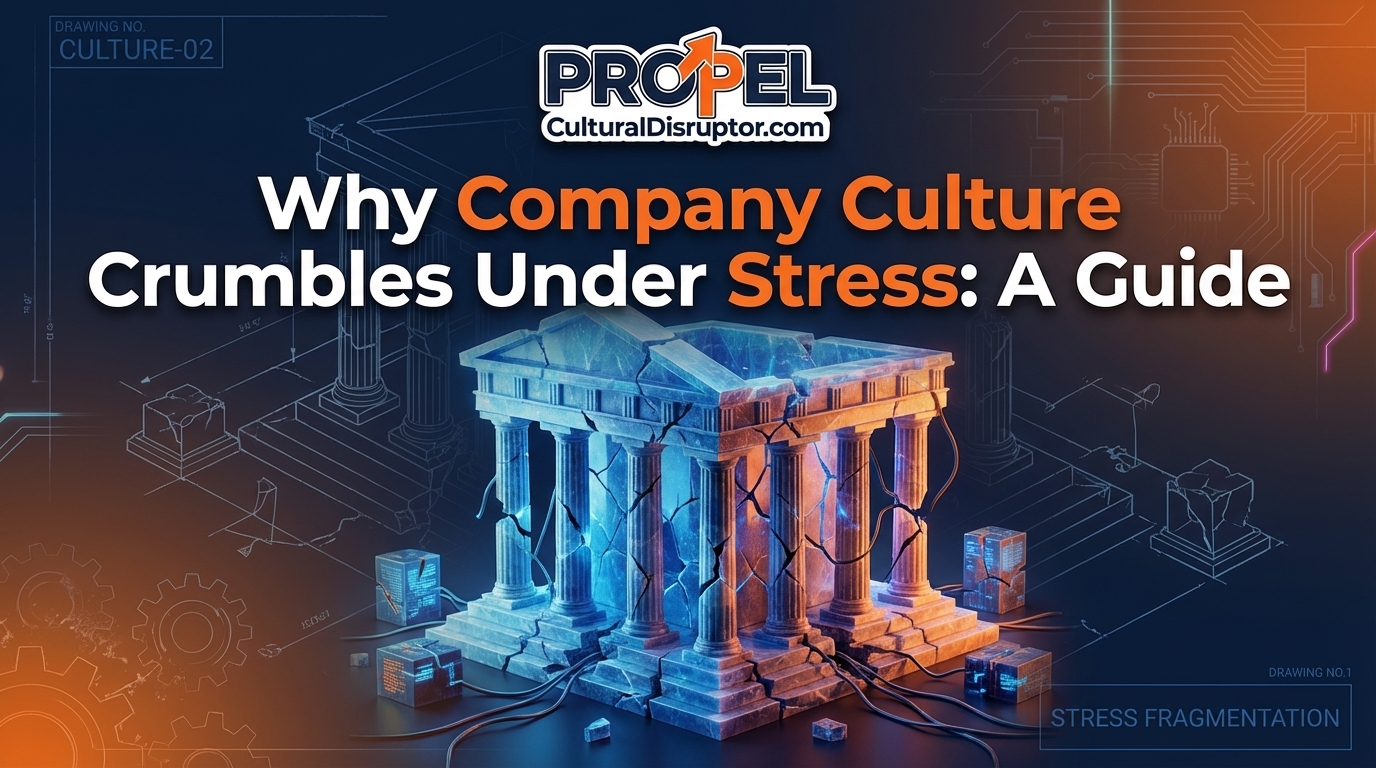
Why Company Culture Crumbles Under Stress: A Guide
Why Company Culture Crumbles Under Stress: The Ultimate Diagnostic Guide
When a business is thriving, culture often feels like a natural byproduct of success. It is easy to be collaborative, innovative, and kind when the quarterly reports are green and the runway is long. However, company culture is not defined by how a team acts during the good times; it is defined by how it functions under extreme pressure. For many organizations, stress acts as the ultimate truth serum, exposing the structural weaknesses in what we at Propel call the "Cultural Operating System." When the pressure mounts, the veneer of core values often peels away, revealing a fragmented, defensive, and ultimately toxic environment.
Why does company culture crumble under stress? Company culture fails under pressure because high-stress environments trigger biological survival mechanisms that override organizational values. When leadership retreats into insularity and the team’s cognitive load exceeds its processing capacity, psychological safety evaporates. Without a resilient Cultural Operating System to stabilize the "wobble," the organization defaults to defensive silos, burnout, and systemic fragmentation.
In this guide, we will diagnose the mechanics of cultural collapse, from the neurobiology of the individual employee to the systemic failures of leadership teams. We will explore why your best people suddenly disengage, why your values seem to vanish when you need them most, and how you can install the necessary stabilizing protocols to ensure your culture flexes rather than breaks.
1. Introduction: Why Stress is the Ultimate Truth Serum for Culture
Most companies treat culture as a "soft" asset—something managed by HR through perks, offsites, and wall-mounted manifestos. At Propel, we view culture as a hard-coded operating system. Just as a software OS can run perfectly under light usage but crash when processing power is maxed out, a company’s culture reveals its true stability only when the organization hits a period of high friction. Stress doesn't necessarily create new problems; it accelerates and amplifies the existing "wobbles" that were already present in your leadership alignment and operational clarity.
When we talk about cultural collapse, we aren't just talking about people being unhappy. We are talking about a functional failure of the collective. Stress forces individuals to prioritize their own safety and survival over the collective goals of the mission. If your culture hasn't been intentionally engineered to withstand this shift, the result is a rapid descent into what we call "Organizational Entropy." This is where energy that should be spent on performance is instead diverted to navigating internal politics, managing anxiety, and protecting one’s own position.
To prevent this, leaders must understand that culture is a precision instrument. It requires constant calibration and a deep understanding of the forces that cause it to fail. By diagnosing the root causes of cultural decay, from biological triggers to leadership insularity, you can begin to build a framework that doesn't just survive stress but actually uses it as a catalyst for greater alignment and performance stabilization.
2. The Anatomy of a Collapse: How Stress Moves from Individual to Organization
The Micro-to-Macro Cascade
Cultural collapse rarely happens all at once; it is a cascading failure that begins at the individual level. It starts with "micro-frictions"—a missed deadline here, a sharp tone in an email there. Under stress, these small moments of tension are no longer brushed off. Because the team’s emotional bandwidth is depleted, these interactions are interpreted through a lens of threat. This creates a feedback loop where individual anxiety leads to team-wide defensive behaviors, eventually manifesting as a systemic breakdown in collaboration.
The Symptoms of Burnout as Cultural Toxins
Burnout is often viewed as a personal mental health issue, but in the context of high-performance teams, it is a primary driver of cultural decay. The three pillars of burnout—exhaustion, cynicism, and ineffectiveness—act as acid on the bonds of a team. Exhaustion leads to poor decision-making; cynicism destroys trust and psychological safety; and ineffectiveness creates a sense of hopelessness. When a critical mass of your team enters this state, the culture shifts from a "growth mindset" to a "survival mindset," where the primary goal is simply to make it to the end of the day.
The High Cost of Disengagement
When culture crumbles, the first thing you lose is your "discretionary effort." This is the extra mile your employees go because they believe in the mission. Under stress, if the culture feels predatory or unsupportive, that effort vanishes. The financial impact of this disengagement, followed by the high cost of turnover as your best talent seeks more stable environments, can be catastrophic for a growing company. Stabilizing the culture is not just a people initiative; it is a fundamental requirement for protecting your bottom line.
3. The Biological Bottleneck: Why Your Brain Can't 'Live the Values' Under Threat
The Neurobiology of Culture: Cortisol vs. Collaboration
One of the most overlooked aspects of cultural collapse is the literal neurobiology of the human brain under pressure. When an organization experiences high levels of stress—whether through market volatility, layoffs, or aggressive deadlines—the brain’s Hypothalamic-Pituitary-Adrenal (HPA) axis is activated. This floods the system with cortisol and adrenaline, shifting the brain’s resources away from the prefrontal cortex (the seat of logic, empathy, and complex problem-solving) and toward the amygdala (the center for fight-or-flight responses).
The Prefrontal Shutdown
This biological shift means that, quite literally, your employees lose the neurological capacity to "live your values" when they are terrified. Empathy requires a functioning prefrontal cortex; high-level collaboration requires executive function. If your workplace is a high-cortisol environment, you are asking your team to perform complex social and intellectual tasks with a brain that is currently optimized for physical survival. This is why "hustle culture" often backfires; by keeping employees in a state of perpetual threat, you are disabling the very mental faculties needed to solve the company’s problems.
Cognitive Load Theory in Cultural Context
Cognitive Load Theory suggests that our brains have a finite amount of processing power. When the environment is filled with uncertainty, rumor, and fear, a massive portion of that "mental bandwidth" is consumed by the effort of scanning for threats and managing anxiety. This leaves very little room for actual work. A crumbling culture is essentially a system experiencing a "processing failure." By reducing the noise and increasing psychological safety, you clear the cognitive path for high-performance output.
4. The 5 Warning Signs Your Culture is Reaching a Breaking Point
Before a culture fully collapses, it sends out warning signals. Identifying these early is critical for performance stabilization. If you notice more than two of these signs, your Cultural Operating System is likely experiencing significant friction.
Communication Silence Meetings become quiet; no one asks questions. Loss of psychological safety and feedback loops. Shadow Channels Explosion of private Slacks and off-record venting. Rumors replace facts; trust in leadership erodes. The "Always-On" Grind Emails sent at 2 AM become the expected norm. Systemic burnout and eventual talent drain. Selective Value Application Values are ignored for "top performers" who are toxic. Total loss of organizational integrity and alignment. Hyper-Defensiveness Errors are hidden; blame is shifted immediately. Innovation stops as everyone plays it safe.5. The Insularity Trap: Why Leaders Fail at the Moment They are Needed Most
The Instinct to Retreat
When the stakes are high, many leaders fall into the "Insularity Trap." Under stress, the natural human instinct is to hunker down, talk only to a small inner circle, and stop the flow of information until "things are figured out." This is a catastrophic mistake. In the absence of information, employees do not assume the best; they assume the worst. Rumors fill the vacuum, and the lack of visibility from the top is interpreted as a lack of care or, worse, a sign of impending doom.
Physical vs. Virtual Presence
In a remote or hybrid world, this insularity is amplified. A leader who doesn't show up on Zoom or engage in public channels during a crisis is effectively invisible. This "virtual absence" creates a sense of abandonment. Leadership visibility isn't just about giving speeches; it’s about being present in the trenches, demonstrating empathy, and acknowledging the difficulty of the situation. At Propel, we teach that leadership is the "glue" of the OS—if the glue dries up, the components fall apart.
The Alignment Gap
The greatest cultural damage occurs when there is a visible gap between a leader’s stated values and their actual executive behavior during stress. If you preach "wellbeing" but demand 80-hour weeks during a crunch, you aren't just being a demanding boss; you are breaking the trust of the Cultural OS. This misalignment creates a cynical workforce that views company values as corporate propaganda rather than a shared mission.
6. Strategic Interventions: Practical Frameworks to Protect Culture in High-Stakes Environments
Lead With Transparency and Radical Honesty
To stop a culture from crumbling, you must flood the system with clarity. This means being honest about the challenges the company is facing. Employees can handle bad news; what they cannot handle is the anxiety of not knowing. Radical transparency reduces the cognitive load required to guess what is happening, allowing the team to refocus their energy on solving the actual business problems.
Prioritize Psychological Safety Above All Else
Psychological safety is the belief that one will not be punished or humiliated for speaking up with ideas, questions, concerns, or mistakes. In a high-stress environment, this is the first thing to go. Leaders must actively work to rebuild it by modeling vulnerability themselves. If the CEO admits they are stressed or that they made a mistake in a recent decision, it gives the rest of the team permission to be human, which lowers the collective cortisol levels and restores functioning to the prefrontal cortex.
Empathy and Recognition: The Emotional Glue
Under pressure, we often focus solely on metrics and milestones, forgetting that humans drive those numbers. Small acts of empathy and recognition act as "cultural stabilization." Acknowledging the hard work of a team member during a difficult week isn't just a "nice to do"; it is a critical intervention that reinforces their value to the organization and helps prevent the cynicism that leads to burnout.
7. Turning Pressure into Polishing: Using Crisis as a Catalyst for Cultural Growth
While stress can destroy a weak culture, it can also act as a "refiner’s fire" for a strong one. Organizations that have installed a resilient Cultural Operating System often find that they emerge from crises stronger than before. This is because high-stakes environments force a level of focus and cooperation that isn't possible in peacetime. When a team successfully navigates a crisis together, it creates a deep sense of shared identity and collective efficacy.
To turn pressure into polishing, leaders must frame the stress as a shared challenge rather than an individual burden. This requires "Strategic Crisis Management" that includes clear simulation training and post-mortem analyses. Instead of looking for someone to blame when things go wrong, the focus is on identifying where the system failed and how to patch the "wobble" for the next time. This shifts the culture from one of fear to one of continuous learning and precision delivery.
Furthermore, crises offer a unique opportunity to prune toxic elements that were tolerated during easier times. If a high-performing but culturally toxic individual becomes a liability under stress, addressing that issue sends a powerful message to the rest of the organization: that the health of the culture is non-negotiable, even when things are difficult. This builds long-term performance that lasts.
8. Cultural Recovery: How to Rebuild After the Crumble
If your culture has already begun to crumble, you need more than a pep talk; you need "Post-Collapse Surgery." This is a systematic process of identifying the points of failure and rebuilding trust through consistent, evidence-based actions. You cannot fix a cultural breach with words; you must fix it with the re-installation of clear operating protocols and leadership alignment.
Step 1: Debridement. Just like in medicine, you must remove the "dead tissue." This means identifying the behaviors, and sometimes the individuals, that are actively poisoning the environment. You cannot build a healthy culture on a foundation of unresolved toxicity.
Step 2: Realignment. Conduct an honest assessment of the gap between your stated values and your team’s actual experience. Use tools like the Propel Organizational Assessment to identify exactly where the friction is occurring. Is it a lack of clarity? Is it a leadership team that isn't speaking with one voice?
Step 3: Stabilization. Re-establish the basics. Clear communication cadences, defined roles and responsibilities, and visible leadership presence. These are the "vitals" of your organization. Once these are stable, you can begin the long-term work of rebuilding the deep trust and psychological safety that were lost during the crumble.
9. Conclusion: Building a Culture That Flexes Instead of Breaks
The ultimate goal of any executive should be to build a culture that is "antifragile"—one that doesn't just resist stress but actually improves because of it. This requires moving away from the idea of culture as a static feeling and toward the reality of culture as a dynamic, high-precision operating system. By understanding the neurobiological, cognitive, and systemic forces at play, you can design an organization that maintains clarity and performance no matter how high the pressure rises.
If you are currently feeling the "wobble" in your organization—if the stress is starting to show in the form of silenced voices, shadow channels, or rising turnover—now is the time to act. A crumbling culture is an early warning sign of a failing business. By diagnosing the friction early and installing a resilient Cultural OS, you ensure that your team remains aligned, your mission remains clear, and your performance lasts through any storm.
Ready to Get Started?
Propel is a fully integrated cultural operating system designed to detect issues early with people and performance, helps maintain clarity under pressure, and builds teams people don't want to leave.
Visit Our Homepage


